 Skip to content
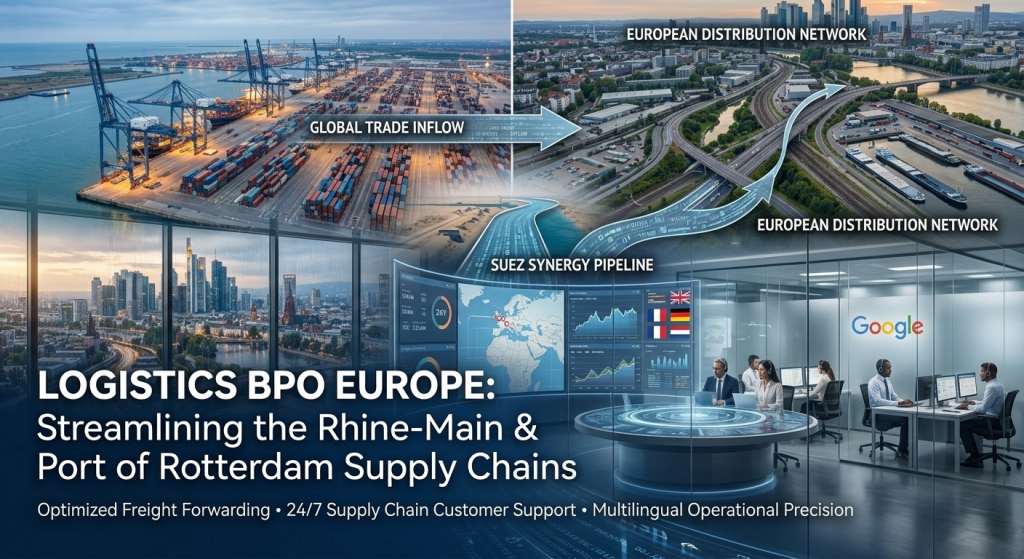
The connection between the Suez Canal corridor and Western Europe’s largest freight hubs is a natural strategic alliance.
Why Logistics BPO Europe is Critical for Modern Freight Forwarding
Outsourcing key administrative and customer-facing tasks allows supply chain giants to scale up rapidly without overhead constraints:
Suez Canal Synergy: Operating from Egypt offers an unmatched geographical and cultural vantage point, bridging Eastern manufacturing origins with Western European destinations.
Continuous Operations: Modern trade never sleeps. Utilizing a Logistics BPO Europe framework ensures that customs documentation, freight tracking, and delivery troubleshooting operate 24/7/365, mirroring the continuous movement of vessels and trucks.
Multilingual Expertise: Managing shipments moving into Rotterdam or distributed throughout the Rhine-Main region requires flawless communication in English, Dutch, German, and French—skills deeply embedded in modern nearshore talent pools.
2. Optimizing Supply Chain Customer Support and Freight Forwarding
When evaluating freight forwarding outsourcing or setting up dedicated supply chain customer support, balancing cost, language proficiency, and technical familiarity is paramount.
| Operational Feature | Nearshore (Egypt BPO) | Onshore (Western Europe) | Traditional Offshore (Asia) |
| Cost Efficiency | High (50-60% savings) | Low (High labor overhead) | High (Low base cost) |
| Language & Cultural Fit | High (Native-level European languages) | High (Local expertise) | Variable (Time zone & language gaps) |
| Time Zone Alignment | Perfect (EET/CET real-time overlap) | Perfect (Same zone) | Difficult (Significant night-shift reliance) |
Choosing a specialized provider eliminates the common pitfalls of traditional offshoring—such as severe time-zone lag or language barriers—while providing the heavy infrastructure necessary to manage complex customs clearance, billing verification, and transport scheduling.
In the logistics sector, a delay in documentation is just as costly as a delay at sea. Specialized back-office teams can handle the heavy lifting of administrative tasks:
Freight Forwarding Outsourcing: From processing Bills of Lading (BoL) to managing customs manifests and tracking container statuses, dedicated teams ensure paperwork is flawless before cargo hits the docks.
Proactive Supply Chain Customer Support: Instead of waiting for a client to report a delayed shipment, BPO teams proactively monitor ETA deviations, coordinate with port authorities, and notify stakeholders in real-time, preserving crucial B2B relationships.
The Verdict: The Future of Agile Logistics
To keep pace with the massive throughput of the Port of Rotterdam and the industrial demands of the Rhine-Main region, modern logistics companies must look beyond traditional borders.
Integrating a robust logistics BPO Europe strategy allows your business to leverage a highly skilled, multilingual workforce located at the literal crossroads of global maritime trade. By combining geographic alignment with significant operational cost advantages, your supply chain remains resilient, compliant, and ready for whatever the global market demands next.
